












Thermal validation and qualification are critical steps to guarantee the integrity of temperature-sensitive products, particularly in the pharmaceutical, biotechnology, and healthcare logistics sectors. Faced with strict regulatory requirements and complex supply chains, companies must rely on rigorous methods, standardized tests, and reliable performance evidence.
Understanding thermal qualification
Thermal qualification consists of demonstrating, with supporting evidence, that a system (packaging, transport, or storage) maintains the required temperature conditions throughout its entire period of use.
It is part of an overall quality approach including:
- Risk management
- Regulatory compliance (GDP, AFNOR standards)
- Performance traceability
Three levels are generally distinguished:
- Design Qualification (DQ): validation of the design
- Operational Qualification (OQ): testing under controlled conditions
- Performance Qualification (PQ): validation under real-world conditions
Main thermal validation methods
1. Climate chamber testing
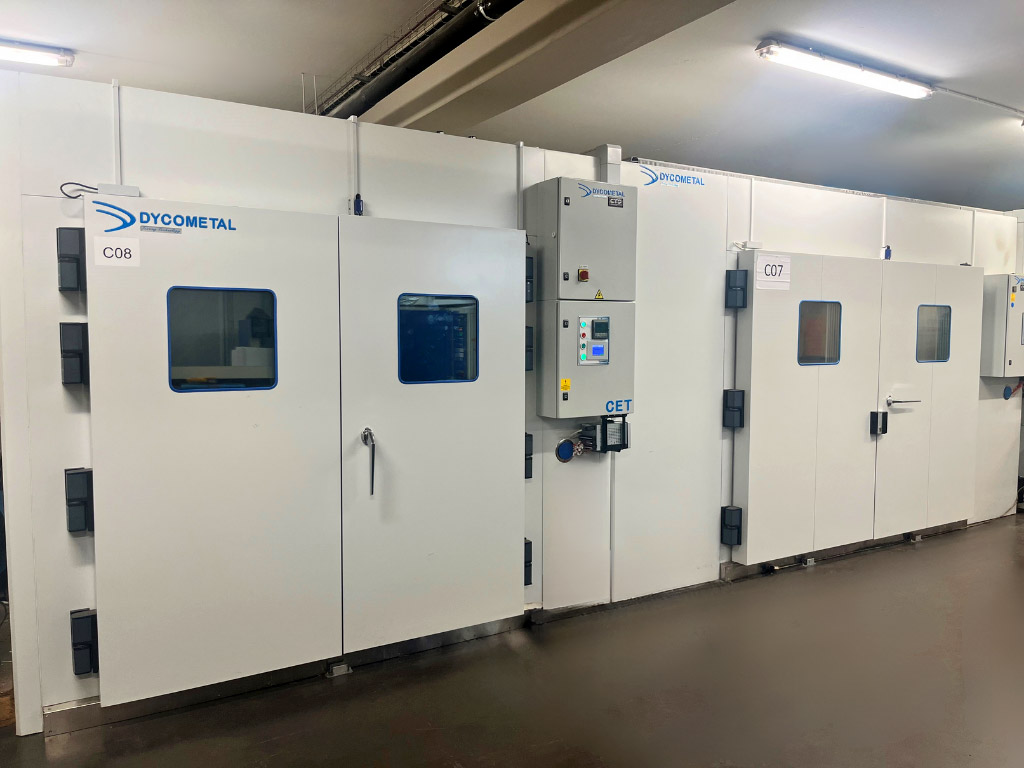
Climate chambers make it possible to simulate extreme transport conditions (summer, winter). At EMBALL’ISO, these tests rely on:
- 8 climate chambers and 2 cold chambers
- Standardized profiles (AFNOR, ISTA)
- Realistic multi-temperature scenarios
Objective: verify the thermal performance of packaging over a defined period (24h, 48h, 72h, or more).
2. Thermal mapping
Mapping consists of analyzing the temperature distribution within a given volume (packaging or chamber). It allows:
- Identification of critical zones (hot/cold spots)
- Optimization of product placement
- Validation of thermal uniformity
Example: an insulated parcel may show an internal variation of several degrees depending on sensor position.
3. Real-World performance testing
Field tests complement laboratory trials. They include:
- Pilot shipments
- Onboard temperature data loggers
- Analysis of deviations vs. theoretical profiles
This data is essential to demonstrate the system’s robustness under real logistical conditions.
4. Qualification of insulated packaging
Packaging is tested according to:
- Its ability to maintain a temperature range (+2°C/+8°C, +2°C/+25°C, +15°C/+25°C, -25°C/-15°C)
- Its thermal autonomy
- Its resistance to logistical hazards
Solutions developed may include:
- Cooling bricks/ice packs
- Technical insulation
- Passive systems
5. Standardized protocols and reference frameworks
Validations rely on recognized standards:
- AFNOR (climate profiles)
- ISTA (transport and packaging)
- GDP (Good Distribution Practices)
These frameworks ensure regulatory compliance and facilitate audits.
Proof of performance and documentation
Thermal qualification is not limited to testing: it must produce complete documentation. Deliverables include:
- Detailed validation reports
- Sensor data
- Statistical analyses
Usage recommendations
These documents are essential for:
- Quality audits
- Health authorities
- Internal traceability
Extend the lifespan of packaging.
Better organize return flows.
Reduce logistics waste.
Limit the overall environmental impact.
Preconditioning thus becomes a strategic link between operational performance and sustainable logistics.
EMBALL'ISO: A reference Laboratory in thermal qualification
For more than 35 years, EMBALL’ISO has supported healthcare industry players in mastering the cold chain through its Research & Innovation laboratory.
Some key figures:
- 500 m² of ISO 9001-certified metrology laboratory
- More than 1,000 tests carried out each year
- 8 climate chambers and 2 cold chambers
The EMBALL’ISO Study Laboratory covers the entire validation cycle:
Design and development
- Custom solutions adapted to logistical constraints
- CAD modeling tools
- Rapid prototyping for field validation
Validation and qualification
- Testing under simulated conditions according to protocols
- Qualification under real-world conditions
- Drafting of files compliant with regulatory requirements
- ISTA member
Operational support
- Loading studies to optimize costs
- Qualification of logistics processes
- SOP drafting
- Team training
As Klesti Luli, Head of the Research Laboratory, notes:
“Every client request is unique. We continuously develop new solutions to help you master the cold chain while optimizing your costs.”
Toward Innovation: HPPS, VYPE, and new approaches
Innovation in thermal qualification today relies on:
- Advanced data analysis (smart data logging)
- Development of higher-performance insulating materials
- Optimization of logistics flows
- Integration of eco-design
These advances make it possible to reconcile:
- Thermal performance
- Cost reduction
- Reduced environmental impact