












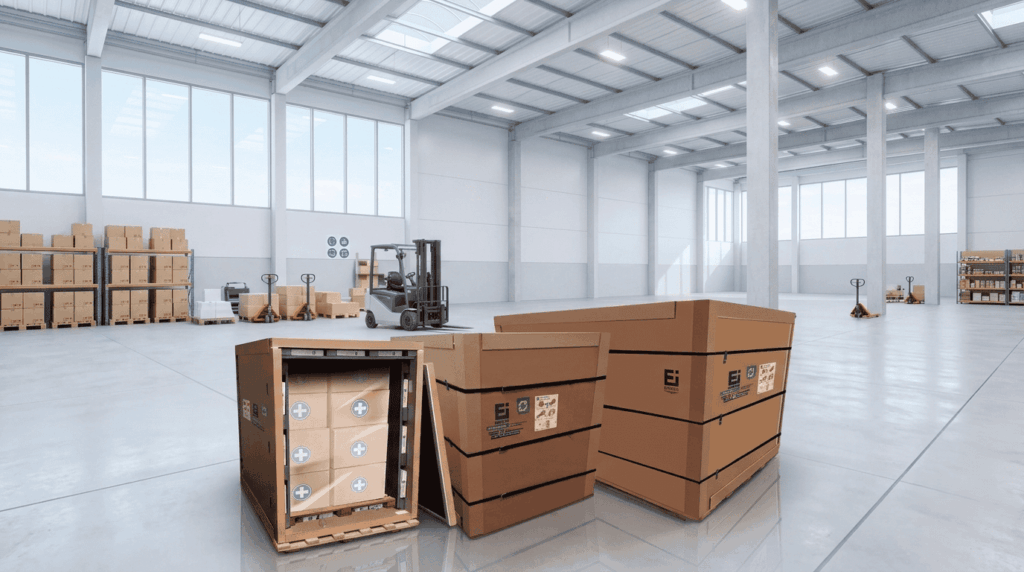
In pharmaceutical and cold chain transport, the weight of insulated packaging directly impacts air and sea freight bills. The Pallet Shipper, a reusable insulated solution designed for palletized transport, acts on three concrete levers: system weight and volumetric weight, the cost of transport per chargeable kilo, and overall supply chain efficiency through a reuse model. This article details, with figures to back it up, how a lightweight Pallet Shipper reduces logistics costs without compromising thermal performance.
What is a Pallet Shipper?
A Pallet Shipper is a palletized, foldable (flat-pack) insulated packaging solution designed to transport palletized loads (Euro Pallet, US Pallet, or 2 Euro or US pallets) at controlled temperature (COOL +2°C/+8°C, TEMPERATE +15°C/+25°C, FREEZE -25°C/-15°C). It comes in several performance levels:
- STANDARD Pallet Shipper: gel-ice bricks, preparation varies depending on outside temperature, usable volume from 1,448 L to 3,410 L.
- PREMIUM Pallet Shipper: phase-change material (PCM) bricks, universal or seasonal packout, usable volume from 1,448 L to 3,410 L.
- PREMIUM + High Performance Pallet Shipper (HPPS): PCM bricks, universal packout, highly insulating panels, usable volume from 1,213 L to 3,095 L, qualified per ISTA 7D profiles.
What sets a high-performing Pallet Shipper apart from most active or rigid solutions on the market is a lightweight flat-pack design, simple and quick assembly, and a design built for reuse.
Volumetric weight: the first cost lever
In air freight, price doesn’t depend solely on the actual weight of the goods but on the chargeable weight, calculated as the higher of actual weight and volumetric weight. Bulky, heavy insulated packaging drives up the bill even when the actual payload is identical.
This is where the lightweight design of a Pallet Shipper makes the difference. On an equivalent Euro Pallet format, the differences in system weight and volumetric weight observed between solutions on the market are significant:
| Solution | System weight | Payload | Volumetric weight |
|---|---|---|---|
| EURO HPPS | 199 kg | 1,249 L | 480 kg |
| VA-Q-Tainer Euro | 440 kg | 1,240 L | 415 kg |
| Skycell 1500C | 497 kg | 1,500 L | 539 kg |
| Credo Cargo | 562 kg | 1,686 L | 634 kg |
| Envirotainer RKN1 | 635 kg | 1,588 L | 826 kg |
In this example, the lightest Pallet Shipper on the market (Euro HPPS) has a system weight up to 3 times lower than competing active solutions, at a comparable usable volume. Less system weight means lower chargeable weight, and therefore a reduced freight bill from the very first shipment.
If the volumetric weight exceeds the actual weight with the pallet of goods inside, billing is based on the volumetric weight and on the pivot weight for active systems. The Pallet Shipper remains one of the most economical solutions.
A reduced external volume, for more units per load
The real benefit of a reduced external volume and lighter system weight isn’t limited to the individual unit transported it affects the entire flow’s organization. A more compact Pallet Shipper allows more units to be loaded onto the same means of transport, which mechanically improves truck and flight fill rates and reduces the number of trips needed for the same volume of goods to be shipped.
For a Euro HPPS format, this translates, for example, into 20 units loaded per truck, versus only 8 to 10 units for some heavier, bulkier rigid solutions. Fewer trips for the same volume transported means a smoother supply chain, fewer transport planning constraints, and better availability of transport resources for the company’s other flows.
The flat-pack (foldable) design of the Pallet Shipper extends this advantage well beyond the outbound trip: on return or in storage, the folded packaging takes up noticeably less space than a non-foldable rigid solution, which limits storage needs and simplifies collection logistics for reuse.
A direct impact on transport efficiency and CO2
Onboard weight doesn’t just weigh on the bill it also weighs on the carbon footprint of transport. A lighter Pallet Shipper reduces CO2 emissions during the transport phase.
The Reuse & Reverse model: the second cost lever, over time
EMBALL’ISO’s Pallet Shippers are reusable, and EMBALL’ISO has set up a fully free Reuse & Reverse service for its customers. After use, the Pallet Shipper is collected by EMBALL’ISO, avoiding waste management on the customer’s end. The Pallet Shippers are then cleaned, repaired if needed, and repositioned if necessary before being reused.
- Free collection: pickup handled and subsidized, through a service network available in more than 80 countries and 15+ service centers across 4 continents.
- Reconditioning: quality control, cleaning, and repair at the service center, to restore like-new performance.
- Repositioning: local reuse or low-carbon repositioning via sea freight if needed.
- Full traceability: tracking via QR code / RFID and traceability software, ensuring compliance and centralized management of expiry dates through a dedicated portal.
- Average collection rate observed: 70 to 80% of Pallet Shippers, depending on the geographic area.
This circular model reduces the costs of purchasing new packaging and managing waste, while also improving the environmental footprint of the logistics flow.
In summary
The Pallet Shipper acts on logistics costs at two complementary levels: a lightweight system weight and reduced volumetric weight that mechanically lowers chargeable weight and improves load fill rates, and a Reuse & Reverse reuse model that allows the packaging to be reused many times while reducing waste and carbon footprint. For any pharmaceutical cold chain looking to balance thermal performance, transport efficiency, and environmental impact, onboard weight is a metric worth tracking.
Frequently Asked Questions
- Is the Pallet Shipper compatible with several pallet formats? Yes. There are Pallet Shippers for Euro pallets, US pallets, or 2 Euro or US pallets, with usable volumes ranging from 1,213 L to 3,410 L depending on the model
- What is the guaranteed thermal performance duration? Up to 144 hours for the HPPS (ISTA 7D qualification) and up to 120 hours for the STANDARD/PREMIUM Pallet Shipper, across the COOL, TEMPERATE, and/or FREEZE ranges.
- Who covers the collection costs for reuse? Collection costs are managed and covered by the Reuse & Reverse network provider, at no additional cost to the shipper.
- What happens if the Pallet Shipper is damaged upon return? A Pallet Shipper is only put back into the reuse circuit if it is in good condition, with normal wear and no missing parts.
- Does the flat-pack format impact storage costs? Yes, the foldable design reduces storage and return footprint, which limits ancillary logistics costs compared to non-foldable rigid solutions.