











November 13, 2026
In brief
- Insulated packaging alone cannot guarantee cold chain integrity. It must be qualified, correctly pre-conditioned and used by operators who follow the right procedures.
- Reliable cold chain packaging is developed in 4 stages: customer brief, CAD design with rapid prototyping, laboratory thermal validation, and a validation report that meets audit requirements.
- Ecodesign and the EU Packaging and Packaging Waste Regulation (PPWR) are accelerating the shift from single-use to reusable systems.
What is reliable cold chain packaging?
Reliable cold chain packaging (also called insulated or isothermal packaging) is packaging whose thermal performance has been demonstrated through testing under real shipping conditions, not just calculated on paper. It protects the product for the full duration of transport, is easy and safe to handle, and limits environmental impact.
For Klesti Luli, the approach rests on three principles: start from the customer’s real constraints, validate through testing rather than assumption, and apply an ecodesign mindset from the first sketch, so that protection, usability and CO₂ reduction are considered together.
How is a customised insulated shipper designed?
Every request is unique, so EMBALL’ISO can develop tailor-made solutions. The process follows four stages:
| Stage | What happens | Benefit |
|---|---|---|
| 1. Brief | Detailed discussion of payload dimensions, shipping duration, temperature range and logistical constraints | The design starts from real operational needs |
| 2. CAD design | Computer-aided design by the design office, with ecodesign to limit material use and optimise transport | Precision from the earliest stage |
| 3. Rapid prototyping | Physical prototypes to test ergonomics, ease of use and feasibility with the customer | Avoids costly surprises before production |
| 4. Thermal validation | Laboratory testing, with results fed straight back into the design by the design office, R&D and lab | A solution that is both high-performing and sustainable |
This short loop between design and testing is what keeps the process agile.
How does a laboratory validate cold chain packaging?
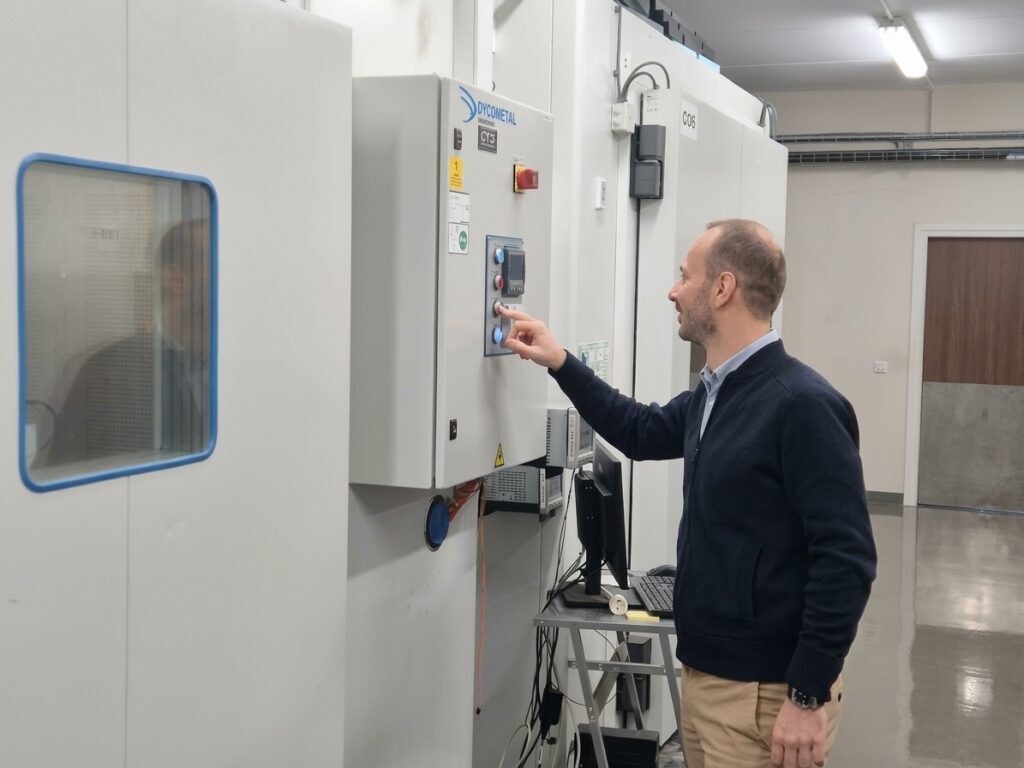
EMBALL’ISO’s Research & Innovation laboratory is a 500 m² ISO 9001-certified metrology facility with 8 climatic chambers and 2 cold rooms. It reproduces the full range of transport conditions and carries out more than 1,000 tests a year.
Each qualification is documented in a complete validation report designed to meet regulatory and audit requirements. EMBALL’ISO is also an ISTA member, and Klesti Luli has held the ISTA Certified Packaging Dynamics Professional (PDP) certification since June 2025, keeping the test approach aligned with recognised industry best practices.
Why can't packaging alone guarantee cold chain integrity?
Much of the real risk lies outside the packaging itself. Pharmaceutical companies must:
- qualify their packaging;
- be ready for audits;
- pre-condition components correctly;
- ensure operators follow the right procedures throughout the process.
EMBALL’ISO supports customers beyond the product: engineering support, thermal design and qualification, regulatory guidance, pre-conditioning services, operational support during shipping, qualification of logistics processes, drafting of SOPs (standard operating procedures) and training of operational teams. The goal is for customers to feel confident in their whole cold chain, not just in the insulated packaging.
How does design reduce costs and improve operator safety?
Good design reduces cost across the whole supply chain:
- Lightweight: EMBALL’ISO pallet shippers are among the lightest on the market, lowering transport costs and CO₂ emissions.
- Flat-packed delivery: it optimises logistics, minimises storage space and makes repositioning by sea freight cost-effective.
- Fast, ergonomic assembly: it reduces handling time, improves operator satisfaction and helps prevent back strain.
- Load optimisation studies: they help customers reduce transport costs.
How does a reusable shipper stay reliable over time?
The real challenge is not deploying reusable packaging but managing its return, refurbishment and redeployment on a global scale. Consistent performance from one use to the next depends on two things: rigorous refurbishment and the validation work done in the laboratory.
EMBALL’ISO relies on one of the largest fleets of reusable pallet shippers, a global collection and recovery network, and integrated Reuse & Reverse Logistics (repair, refurbishment and repositioning). Because the teams that design and validate the solutions also define how they are refurbished, a shipper performs as reliably on its tenth journey as on its first.
How does the EU PPWR affect cold chain packaging?
The EU Packaging and Packaging Waste Regulation (PPWR) makes sustainability a regulatory requirement as well as a business priority. According to Klesti Luli, EMBALL’ISO responds on three fronts:
- Ecodesign: lightweight designs that reduce material use and transport emissions, without compromising protection, which is verified in the laboratory.
- Reusable systems: they extend product lifespan and reduce waste compared with single-use packaging. EMBALL’ISO helps customers move from single-use to reusable and supports their compliance as the PPWR is phased in.
- Impact measurement: Life Cycle Assessment (LCA) expertise ensures environmental claims are based on data.
In the team’s words: the most sustainable package is the one that delivers environmental value throughout its entire lifecycle.
What are the keys to innovation in cold chain packaging?
According to Klesti Luli, innovation relies on close dialogue (with customers and between the design office, R&D and the laboratory), continuous learning from test results and cold chain data, and an agile approach combining CAD, thermal simulation and rapid prototyping to evaluate concepts early. Upcoming priorities: ecodesign, reusable systems and regulatory compliance (including the PPWR), without ever compromising thermal performance.
Frequently asked questions
What is the difference between insulated packaging and a complete cold chain solution?
Insulated packaging is only part of the solution. A complete solution includes qualification, pre-conditioning, operator procedures, training and audit readiness.
How many tests does EMBALL’ISO run each year?
More than 1,000, in a 500 m² ISO 9001-certified laboratory with 8 climatic chambers and 2 cold rooms.
Is reusable packaging as reliable as single-use packaging?
Yes, provided it is rigorously refurbished and validated in the laboratory. EMBALL’ISO offers the same performance from 1st to 10th use.
Does EMBALL’ISO operate internationally?
Yes. For more than 35 years, the company has operated through 13 sites: the United States (2), Mexico, Brazil, France, the United Kingdom, Germany, India (2), Singapore, Vietnam, China and Japan.
How does EMBALL’ISO help customers comply with the PPWR?
By supporting the move from single-use to reusable systems, applying ecodesign, and using Life Cycle Assessment to document environmental gains.
About Klesti Luli
Klesti Luli is Design and Validation Department Manager at EMBALL’ISO, based near Lyon, France. He leads design, validation and R&D activities, with a focus on ecodesign and sustainable packaging. He joined EMBALL’ISO in 2024 after technical and R&D management roles at MM Packaging France. He holds a degree in Packaging Engineering from ESEPAC (European School of Packaging) and a Bachelor’s degree in Chemistry from Clermont Auvergne University, and has been an ISTA Certified Packaging Dynamics Professional (PDP) since June 2025.