










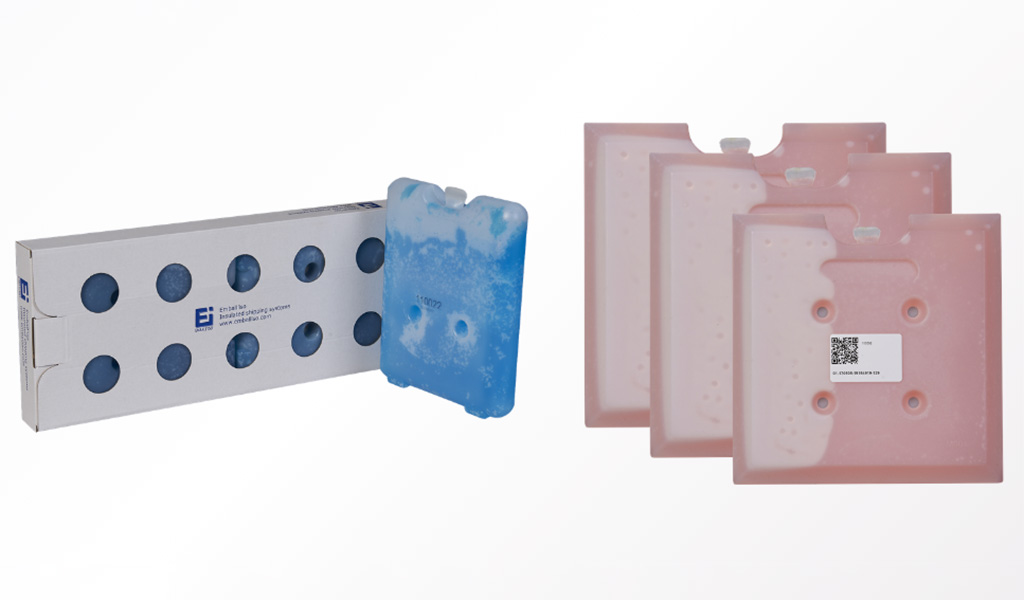
When shipping temperature-sensitive products, the choice of cooling element or “briquette” is the most critical factor in ensuring product integrity. Should you use standard Watergel or advanced Phase Change Materials (PCM)?
At EMBALL’ISO, we guide you in choosing the solution that perfectly matches your logistical needs.
Watergel briquettes release cold at 0°C and are ideal for short, simple trips. However, PCM (Phase Change Materials) are superior for shipments over 48 hours. PCM offers “mono-configuration” (same setup year-round) and “thermal hibernation,” maintaining a constant target temperature without the risk of freezing the product.
1. Understanding the two main types of coolants
There are two primary categories of long-duration cooling elements used in isothermal packaging:
- Watergel Briquettes (Eutectic Gels): The most common solution, where water is frozen or cooled to maintain its shape and release cold as it melts.
- Phase Change Material (PCM) Briquettes: These advanced materials solidify or liquefy at a specific temperature. During this “phase change,” the material absorbs or releases energy while maintaining a constant temperature, providing a precise thermal shield.
Note: Both types require a strict pre-conditioning protocol (defined freezing and refrigeration times) to guarantee performance.
2. Challenges of using water-based systems
While economical, Watergel releases cold at 0°C. This creates significant logistical constraints:
- Seasonal Adjustments: You must constantly modulate the number of briquettes based on external temperatures (Summer vs. Winter profiles).
- Operational Complexity: It requires perfect knowledge of the transport cycle and storage conditions (ambient vs. controlled).
- Risk of Temperature Excursions:
- Cold Room Storage: High risk of “low excursions” (freezing the product).
- Ambient Storage: High risk of “high excursions” (overheating).
- Difficult Intercontinental Routes: Shipping from a cold climate to a tropical one (e.g., to DROM-COM) is challenging; you must balance enough energy for the arrival without “freezing” the start of the journey.
3. The advantages of PCM: efficiency and simplicity
PCM briquettes are the gold standard for high-value or long-distance pharmaceutical shipping.
Why choose PCM for 48h+ shipments?
- Year-round mono-configuration: unlike water, PCM allows for the same packaging setup regardless of the season. This simplifies warehouse operations and reduces human error.
- Increased Performance: There is no risk of temperature deviation. The PCM stabilizes at your target temperature (e.g., +5°C, +22°C, etc.).
- Thermal Hibernation: When stored in a +2°C/+8°C environment, +5°C PCM briquettes remain solid (100% energy). They “hibernate,” allowing you to prepare your orders well in advance without losing any cooling power.
4. Comparison table: at a glance
| Feature | Watergel Briquettes | PCM Briquettes |
|---|---|---|
| Release Temperature | Fixed at 0°C | Customizable (Target Specific) |
| Ideal Duration | < 24–48 hours | 48 to 120+ hours |
| Configuration | Changes by season (Summer/Winter) | Mono-configuration (All Year) |
| Risk of Freezing | High (Cold shock at 0°C) | Minimal |
| Preparation | Complex (Variable protocols) | Simple (Standardized) |
5. Expert guidance for your cold chain
Choosing between Water and PCM depends on your product’s sensitivity, your budget, and your destination. At EMBALL’ISO, we don’t just provide boxes; we provide the thermal expertise to secure your global shipments.
Need a customized study for your next shipment?