



27 October 2026
In Brief
In February 2025, Cyclone Garance led to the cancellation of several flights between mainland France and Réunion Island. A pallet of temperature-sensitive products, packed in EMBALL’ISO ISOGO 8L insulated packaging, was held in a cold room at the departure airport for more than 8 days. The total transit time reached 336 hours (14 days). Temperature data loggers showed that the internal temperature remained within the 2–8°C range throughout the entire journey, even as the external temperature reached up to 29°C. The shipment was successfully delivered.
| Indicator | Value |
|---|---|
| Route | France → Réunion Island |
| Period | February 2025 |
| Packaging | ISOGO 8L (EMBALL’ISO) |
| Total transit time | 336 hours (14 days) |
| Time spent in the airport cold room | 8.5 days (from hour 24 to hour 228) |
| Required temperature range | 2–8°C |
| Internal temperature result | Maintained within the 2–8°C range |
| Peak external temperature | Up to 29°C |
The context: a cyclone and cancelled flights
Réunion Island is an island territory where the transportation of medicines, vaccines and other temperature-sensitive products depends almost entirely on air freight. When a major weather event such as Cyclone Garance in February 2025 disrupts air traffic, several flights may be cancelled and transit times can increase without warning.
In this particular case, the pallet remained in a cold room at the departure airport for several days before transportation could resume.
The challenge: maintaining 2–8°C far beyond the planned transit time
Pharmaceutical shipments are generally designed and qualified for a specific transit duration. In this case, unforeseen circumstances significantly extended the shipment’s exposure to potential risks:
More than 8 days spent waiting in a cold room;
A total transit time of 14 days instead of the planned journey duration;
External temperature peaks of up to 29°C.
The challenge was to ensure that the products remained within their required storage temperature range of 2–8°C, regardless of the actual transit time.
The solution: ISOGO 8L insulated packaging
The shipment was protected by ISOGO 8L insulated packaging, designed by EMBALL’ISO for temperature-sensitive products. It combines a cardboard outer box, insulation and thermal conditioning panels to maintain the internal temperature over extended periods.
The results: evidence backed by data
The shipment was monitored using temperature data loggers placed both inside and outside the package. The monitoring graph can be divided into three phases:
Preparation (0–24 hours): Conditioning and dispatch. An external temperature peak of approximately 13°C is visible, with no impact on the internal temperature.
Cold room storage (24–228 hours, or 8.5 days): Stable temperature conditions.
Final delivery (228–336 hours): Several external temperature peaks were recorded, including one reaching approximately 29°C, without affecting the internal temperature.
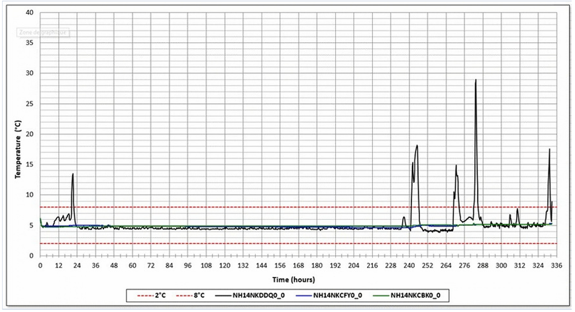
The internal temperature probes recorded temperatures between 2°C and 8°C throughout the full 336-hour period.
Key takeaway: Despite spending 14 days in the logistics chain and being exposed to external temperature peaks of up to 29°C, the shipment remained within the required internal temperature range of 2–8°C. The shipment was successfully delivered.
What this case demonstrates
Actual qualification duration matters: Packaging must withstand delays and disruptions, not just the planned transit time.
Island territories face specific logistical challenges: A weather event can result in several days of waiting, rather than just a few hours.
Data provides the evidence: Temperature data loggers deliver traceable records that can be used to support quality documentation.
FAQ
Can insulated packaging maintain a temperature of 2–8°C for 14 days?
Yes. In this real-life case, ISOGO 8L insulated packaging maintained the internal temperature within the 2–8°C range for 336 hours, equivalent to 14 days.
What happened during Cyclone Garance?
Cyclone Garance, in February 2025, led to the cancellation of several flights to Réunion Island. The pallet remained in a cold room at the departure airport for more than 8 days before final delivery.
What external temperatures did the packaging withstand?
External temperature peaks of up to 29°C were recorded, with no impact on the internal temperature.
How was temperature compliance verified?
Temperature data loggers placed inside and outside the package recorded the temperature throughout the journey. Their readings confirmed that the internal temperature remained within the required 2–8°C range for the entire transit period.
Which products are suitable for this type of packaging?
This type of packaging is suitable for temperature-sensitive products that must be kept between 2°C and 8°C, particularly pharmaceutical products shipped over long or unpredictable transit times. Contact EMBALL’ISO to determine the most appropriate solution for your specific requirements.
À propos d’EMBALL’ISO
EMBALL’ISO conçoit des solutions d’emballage isotherme pour le transport de produits thermosensibles, validées par des expéditions réelles suivies par enregistreurs de température.
Source des données : relevés d’enregistreurs de température d’une expédition réelle France → La Réunion, février 2025.